
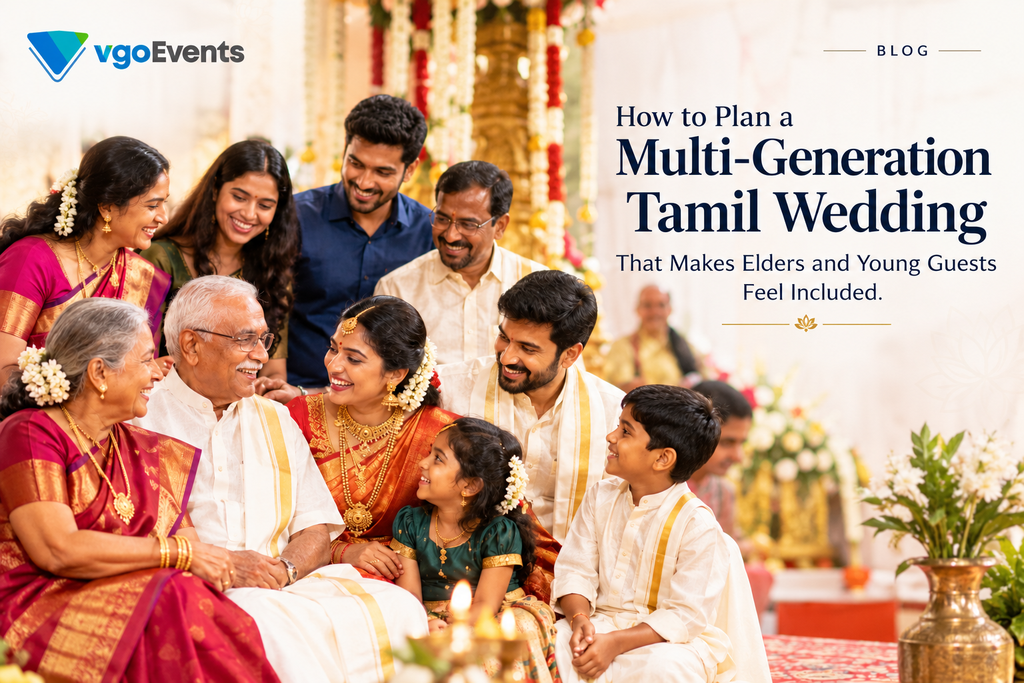
Creating a beautiful Tamil wedding experience where every generation feels welcomed, respected, and part of the celebration.
A Tamil wedding is much more than a ceremony. It is a meaningful gathering of families, traditions, blessings, laughter, and unforgettable memories. From grandparents who carry generations of family wisdom to children experiencing the excitement of a wedding for the first time, every guest brings a special place to the celebration.
However, planning a wedding that comfortably accommodates different generations requires more than beautiful decorations and a well-organised schedule. Elderly guests may need convenient seating, accessible pathways, and sufficient rest. Young adults may appreciate lively entertainment and opportunities to connect, while children need engaging activities and a comfortable environment.
The secret to a successful multi-generation Tamil wedding is simple: plan every detail with every guest in mind.
At VGO Events, thoughtful wedding planning means bringing together traditional values, elegant event design, smooth coordination, and guest comfort to create a celebration that feels welcoming to the entire family.
1. Understand the Needs of Every Generation Before Planning
Every family has its own traditions, preferences, and expectations. Before finalising the wedding venue, decorations, or ceremony schedule, take time to understand what different guests may need.
Grandparents and senior relatives may prefer easy access to the ceremony stage, comfortable chairs, minimal walking, and a quieter place to rest. Parents may need convenient facilities for feeding or supervising children. Younger guests may enjoy interactive entertainment, contemporary photography experiences, and opportunities to socialise.
A simple family consultation can help identify these requirements early.
Consider asking:
- Which elderly relatives may require assistance with walking or seating?
- Are wheelchair access or step-free routes needed?
- Will many guests be attending with infants or young children?
- Which family traditions must be included in the ceremony?
- Are there guests who require specific food arrangements or other accommodations?
- Will guests be travelling from outside the city and need additional assistance?
These answers help create a practical wedding plan that balances family traditions with modern guest expectations.
2. Choose a Venue That Welcomes Everyone
The wedding venue influences the comfort and experience of every guest. A visually impressive venue may look wonderful in photographs, but it must also be easy to navigate and suitable for the family’s needs.
For a multi-generation Tamil wedding, look beyond the stage and dining hall when selecting a venue.
Prioritise accessibility
Check for step-free entrances, ramps where required, accessible washrooms, suitable lifts for upper floors, and clear pathways between the entrance, ceremony area, dining space, and rest areas.
If elderly guests use wheelchairs or walking aids, confirm that the venue can accommodate them safely. Avoid creating unnecessary obstacles with decorative installations, cables, floral arrangements, or tightly packed furniture.
Keep important areas within convenient reach
Where possible, plan the ceremony seating, dining area, washrooms, and resting spaces so that guests do not have to walk long distances. If the venue is large, arrange clear signage and assign family members or hospitality staff to guide guests.
Provide a quiet resting area
Long Tamil wedding celebrations can be tiring, especially for senior guests and families with small children. A quieter space with comfortable seating, suitable ventilation, drinking water, and convenient access can make a meaningful difference.
At VGO Events, venue planning should consider not only how the wedding looks but also how comfortably guests can move through the celebration.
3. Arrange Seating That Makes Elders Feel Respected
Seating is one of the most important details in a multi-generation wedding. Elderly guests should not have to stand for extended periods or search for available chairs during important ceremonies.
Plan seating arrangements before the wedding day and communicate them clearly to the coordination team.
Practical seating ideas include:
- Reserve comfortable seats for grandparents and senior relatives near the ceremony area, with clear sightlines.
- Keep designated wheelchair spaces and companion seating where needed.
- Provide chairs with supportive backs and suitable armrests for guests who may find standing up difficult.
- Ensure reserved seating does not block accessible routes or emergency exits.
- Offer seating near the dining area for guests who need frequent breaks.
- Arrange a suitable balance between family seating, general guest seating, and spaces for children with their parents.
For traditional ceremonies where certain family members participate in specific rituals, coordinate with the family in advance to ensure seating reflects the ceremony’s requirements.
Avoid placing elderly guests too close to loudspeakers, busy entrances, or high-traffic areas. They should be able to enjoy the ceremony without unnecessary discomfort.
A thoughtful seating plan communicates respect without making senior guests feel singled out.
4. Plan the Ceremony Timing Around Comfort and Tradition
Tamil weddings may include several meaningful rituals, and the timing of important ceremonies can be influenced by family customs and auspicious muhurtham timings.
The objective is not to shorten traditions unnecessarily. It is to organise the surrounding schedule so that guests can participate comfortably.
Confirm the muhurtham first
Discuss the required ceremony timing with the family, priest, or relevant officiant before building the event schedule. Once the key timings are confirmed, coordinate the remaining activities around them.
Create a realistic event timeline
Include adequate time for guest arrival, seating, photography, rituals, refreshments, meals, and transitions between event spaces. Avoid scheduling every activity too closely together.
If the wedding begins early in the morning, consider arrangements for breakfast, drinking water, and comfortable waiting areas. For extended celebrations, schedule suitable refreshment breaks.
Communicate timings clearly
Share the schedule with family members, guests, vendors, and the event coordination team. Include practical details such as arrival time, ceremony location, dining arrangements, and transport information where applicable.
Respect the pace of senior guests
Not every guest will be able to stand throughout a long ceremony. Provide seating wherever appropriate, and arrange assistance for guests who wish to move between the ceremony and resting areas.
A well-planned timeline allows the family to honour its traditions while reducing unnecessary waiting and confusion.
5. Preserve Tamil Wedding Traditions With Meaningful Family Participation
Family traditions are at the heart of many Tamil weddings. Rituals, blessings, music, attire, jewellery, family heirlooms, and shared memories can connect generations in ways that contemporary décor alone cannot.
The most meaningful wedding experiences often emerge when family members are given opportunities to participate in ways that feel natural and respectful.
Consider incorporating:
- Grandparents’ blessings: Create an appropriate moment for the couple to receive blessings from senior family members.
- Family stories: Invite relatives to share brief memories or stories during a suitable pre-wedding gathering.
- Traditional music: Include suitable traditional music during selected moments, in consultation with the family.
- Heirloom displays: Present family photographs or meaningful heirlooms in a carefully arranged display, with the family’s permission.
- Cultural explanations: Where appropriate, provide a short explanation of selected rituals for younger guests or relatives unfamiliar with certain traditions.
- Family participation: Involve children and younger relatives in age-appropriate roles that reflect the family’s customs.
Not every tradition needs to be turned into a performance or display. Some moments are best kept intimate and ceremonial.
The aim is to protect the meaning of family customs while helping younger generations understand and appreciate them.
6. Create Children’s Activities Without Distracting From the Ceremony
Children can bring wonderful energy to a wedding, but long ceremonies and crowded venues can be challenging for them and their parents.
A dedicated, supervised children’s activity area can help families enjoy the occasion more comfortably.
Set up a child-friendly activity corner
Depending on the available space and age group, consider:
- Colouring sheets and crayons.
- Simple puzzles and building activities.
- Traditional Indian games suitable for the age group.
- Drawing activities inspired by wedding motifs.
- Quiet books and storytelling.
- A small craft activity using safe, age-appropriate materials.
Keep the activity area away from ceremonial pathways, cooking areas, electrical equipment, and crowded entrances.
Arrange suitable supervision
Activities should be planned with appropriate adult supervision. Clearly communicate whether parents must remain with their children or whether a dedicated childcare provider has been arranged.
Do not assume that event staff responsible for general coordination are also responsible for childcare.
Make room for family needs
If space and facilities permit, provide a quiet feeding or changing area for parents with infants. Ensure families know where it is located.
For younger children, allow flexibility around meal times and rest. A thoughtful children’s plan supports parents while helping the wedding remain enjoyable for guests of all ages.
7. Design Décor That Combines Tamil Heritage With Modern Elegance
Wedding décor should express the family’s identity while keeping the venue practical and welcoming.
Traditional Tamil wedding elements may include flowers, brass or metal decorative pieces, traditional lamps, kolam-inspired patterns, and culturally meaningful colours. These details can be combined with contemporary lighting, refined stage design, elegant seating, and coordinated floral arrangements.
The key is to make the design cohesive rather than overcrowded.
Create a beautiful but functional stage
Ensure that the stage has safe access and sufficient space for the couple, family members, photographers, and ritual participants. If elderly relatives need to join the couple on stage, discuss suitable access arrangements in advance.
Keep pathways clear
Decorative arches, floral installations, props, and lighting equipment should never obstruct accessible routes or create trip hazards.
Consider comfort when choosing lighting and sound
Use lighting that supports clear visibility without causing unnecessary glare. Position speakers thoughtfully and maintain sound levels that allow guests to hear important announcements comfortably.
Make photography inclusive
Plan family photographs so that grandparents and relatives with mobility limitations do not have to stand for long periods or repeatedly travel across the venue. Arrange chairs and coordinate group photographs in advance.
Beautiful décor should enhance the celebration, not make it difficult for guests to participate.
8. Plan Dining and Hospitality With Every Guest in Mind
Food is an essential part of the Tamil wedding experience. From traditional meals served on banana leaves to carefully arranged buffet counters, dining brings family and friends together.
However, dining arrangements should consider more than the menu.
Make dining areas easy to navigate
Ensure clear pathways to dining tables, counters, and washrooms. Provide suitable seating for guests who may find it difficult to stand in queues or eat comfortably without a chair.
Reduce waiting time
Coordinate serving arrangements with the catering team. Where practical, consider assistance for senior guests and others who may have difficulty carrying plates or navigating crowded counters.
Communicate dietary requirements
Ask the family to identify relevant dietary requirements in advance and communicate them clearly to the caterer. Provide accurate food labels where appropriate, and avoid making unverified claims about ingredients or allergen safety.
Keep water and refreshments accessible
Place drinking water and suitable refreshments in convenient locations. For long celebrations, consider refreshments that align with the schedule and the family’s preferences.
Respect the dining tradition
If the family prefers a traditional banana-leaf meal, plan the seating, serving sequence, and guest flow accordingly. If buffet dining is selected, ensure the arrangement supports comfortable movement and sufficient space.
A well-coordinated dining experience helps guests feel cared for and allows the family to focus on celebrating.
9. Use Hospitality Coordination to Make Every Guest Feel Welcome
Even a carefully planned wedding can become confusing when hundreds of guests arrive at the same time. Clear communication and attentive hospitality help the event run smoothly.
Assign designated team members to manage guest arrival, seating guidance, accessibility assistance, schedule updates, and directions between event areas.
Useful arrangements include:
- Welcome desks with clear event information.
- Signage for ceremony halls, dining areas, washrooms, and rest areas.
- A point of contact for elderly guests and families who need assistance.
- Coordination between the wedding planner, venue, catering team, photographers, and family representatives.
- A clear plan for handling schedule changes or unexpected requirements.
- Transport and parking guidance for guests who need additional support.
Where appropriate, provide key information in Tamil and English so that guests can understand directions and announcements comfortably.
Hospitality should feel warm and natural rather than overly formal. A helpful greeting, a clear direction, or assistance finding a seat can shape a guest’s entire experience.
10. Make Younger Guests Part of the Celebration
Young adults and teenagers may connect with weddings differently from older relatives. In addition to participating in the ceremony, they may appreciate opportunities to contribute creatively and spend time with friends and cousins.
Consider inviting younger family members to help with selected tasks, such as preparing a family photo display, assisting with guest welcome activities, or coordinating a suitable music playlist for a separate celebration.
A photo corner with family-friendly props, a shared family memory display, or a well-planned space for informal photographs can encourage interaction between relatives.
If entertainment is included, schedule it around the main rituals and ensure that sound, movement, and crowd flow do not interfere with the ceremony.
The objective is not to make every wedding activity appeal equally to every age group. It is to give younger guests meaningful ways to participate while preserving the occasion’s cultural significance.
11. Prepare a Multi-Generation Wedding Planning Checklist
Before the wedding day, use a practical checklist to review the most important arrangements.
Venue and accessibility
- Confirm step-free access and suitable routes.
- Check accessible washrooms and lift availability where relevant.
- Arrange resting spaces and comfortable seating.
- Confirm clear pathways around décor and furniture.
Ceremony and timing
- Confirm the muhurtham and essential rituals.
- Prepare a realistic event schedule.
- Share timings with family members and vendors.
- Plan suitable breaks and refreshments.
Family and traditions
- Identify important family customs.
- Confirm the roles of participating relatives.
- Arrange appropriate moments for blessings and photographs.
- Obtain permission before displaying family photographs or heirlooms.
Children and young guests
- Prepare age-appropriate activities.
- Confirm supervision arrangements.
- Identify feeding, changing, or quiet spaces where possible.
- Keep activity areas separate from busy ceremonial routes.
Dining and hospitality
- Confirm the catering plan and dietary requirements.
- Provide clear directions and signage.
- Arrange assistance for guests who need it.
- Keep water and refreshments accessible.
Final coordination
- Share the event schedule with the coordination team.
- Confirm vendor responsibilities.
- Prepare a contact list for key family representatives.
- Review the venue layout and guest movement plan before the event.
12. How VGO Events Helps Create a More Inclusive Tamil Wedding
At VGO Events, a memorable wedding is about more than the stage, flowers, lighting, or photographs. It is about creating an environment where the family’s traditions are respected and guests can participate comfortably.
A thoughtful planning approach brings together décor, venue layout, hospitality, scheduling, and event coordination to support the entire celebration.
From designing a traditional wedding setting with a modern finish to coordinating guest movement and arranging practical event details, every decision should serve the family’s vision and the comfort of its guests.
The right planning process begins with listening. By understanding the family’s priorities, identifying guest requirements, and coordinating the event details in advance, a wedding can feel more organised, welcoming, and personal.
Whether you are planning an intimate family ceremony or a large Tamil wedding celebration, VGO Events can help you explore event design and coordination options suited to your requirements.
Your wedding should be remembered not only for how beautiful it looked, but also for how warmly every generation was welcomed.
Conclusion: A Wedding That Brings Every Generation Together
A successful multi-generation Tamil wedding balances tradition, comfort, hospitality, and celebration. Comfortable seating helps elders participate with dignity. Thoughtful timing respects ceremonial requirements. Accessible facilities support guests with different mobility needs. Children’s activities help families enjoy the occasion, while meaningful family traditions create lasting connections between generations.
When these details are considered from the beginning, the wedding becomes more than a well-decorated event. It becomes a shared family experience in which grandparents, parents, young adults, and children all have a place.
Planning a Tamil wedding with VGO Events? Contact our team to discuss your wedding vision, décor preferences, guest requirements, and event coordination needs. Let’s create a celebration that honours your traditions and welcomes every generation with care.
VGO Events — Thoughtful Planning. Beautiful Celebrations. Meaningful Memories.
Click the link below to explore more of our beautiful product collection.
German Silver Uruli
Click the link below to explore our beautiful collection of premium brass products.