
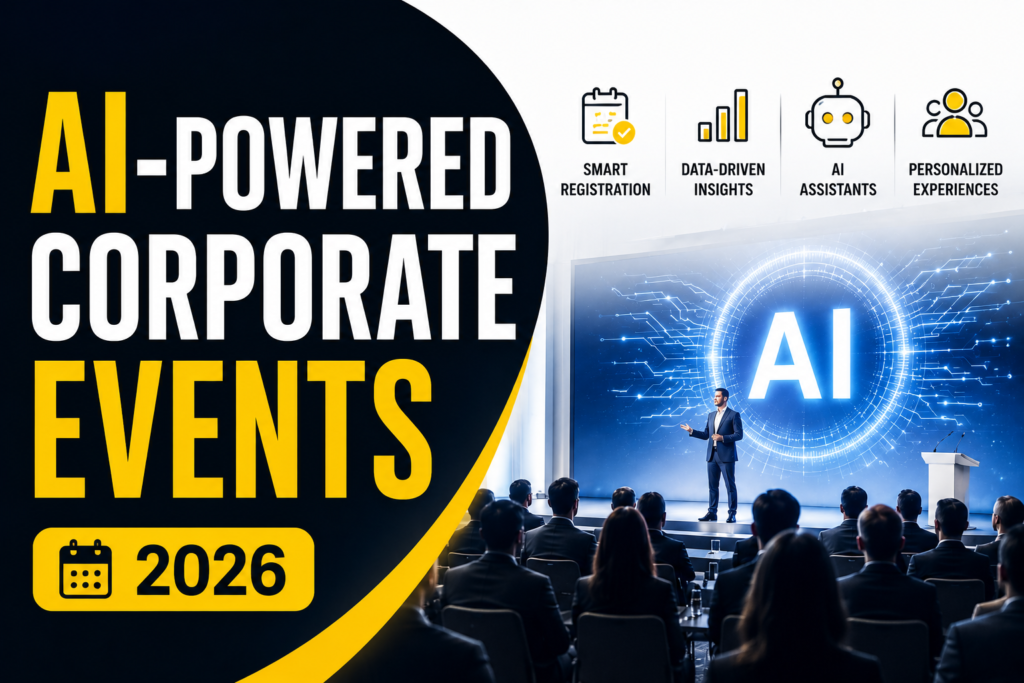
Imagine you walk into a corporate event and it feels like someone planned it for you. The sessions on the agenda match what you genuinely care about, and the networking app nudges you toward people you’d actually want to meet, not just whoever happened to register. Check-in takes ten seconds, and when you have a question, an assistant answers it on the spot. If the audience starts losing interest in a session, the schedule quietly adjusts.
That’s not a pitch for some far-off future, that’s what well-run corporate events look like right now, in 2026.
AI has quietly become the backbone of modern event planning, not in a flashy, headline-grabbing way but in a deeply practical one. It’s handling the grunt work that used to exhaust planners, and it’s enabling the kind of personalization that used to be impossible at scale. For companies in Chennai, Coimbatore, Bangalore, and across India, where demand for corporate experiences has shot up, this shift matters because the bar has moved. Attendees have been to enough forgettable conferences, and they’re not going to sit through another one.
Why the Old Way Wasn’t Working
Before AI became accessible, event planning was a grind. Coordinators managed everything through spreadsheets, chased vendors over email chains that went nowhere, and spent days on tasks that could have taken minutes. For all that effort, the experience on the other end was pretty generic with the same agenda for everyone, the same networking scramble, and the same hit or miss sessions.
AI didn’t just speed things up, it changed what was actually possible.
What’s Actually Changing
The most visible shift is personalization. Event platforms can now pull together data on attendee backgrounds, interests, and past behavior to build genuinely tailored experiences with relevant sessions, curated networking suggestions, and schedules that reflect what each person is actually there for. It sounds small, but the difference between a session that clicks and one that doesn’t is often just relevance.
Networking has also gotten smarter, and for most professionals, that’s the real reason they show up, not the keynotes. AI-powered apps now match people based on industry, career stage, and shared interests instead of leaving it to chance encounters at the coffee station. You can walk into a startup summit or a leadership forum and already know who you want to track down before the day even starts.
On the operational side, AI chatbots have taken over a lot of the logistics that used to drain event staff, including registration questions, ticket confirmations, session changes, and venue directions. Attendees get instant answers, while organizers can focus on the things that actually require human judgment.
Behind the scenes, predictive analytics are changing how planners approach strategy. Rather than guessing which sessions will be popular or when attendance tends to drop, they now have real data to work with, forecasts on engagement, marketing effectiveness, and return on investment that make it easier to refine the next event before the current one is even over.
Hybrid events deserve a mention too, since they’re still the default for many organizations. AI has made the virtual side of these events genuinely better with real-time captions, live language translation, and interactive tools that keep remote attendees engaged rather than just watching a stream. Companies that run events across India and beyond are finding this especially useful when they need to connect local audiences with international speakers or teams.
Even marketing has shifted. Campaigns for corporate events used to be fairly broad with blast emails and generic social ads. Now they’re targeted in a way that actually makes sense, reaching the right people with messaging tailored to what they care about, and registration numbers reflect it.
What This Means for Companies Planning Events
The organizations getting the most out of AI aren’t the ones using every feature available. They’re the ones who’ve figured out where it actually solves a real problem, whether that’s cutting registration friction, making networking less awkward, or helping planners stop guessing and start making decisions based on data.
For event management companies in Coimbatore and across India, this is both an opportunity and a pressure. Clients have seen what good looks like now, and they expect more. The good news is that the tools to deliver it are already here, it’s just a matter of putting them to work.
Conclusion
Nobody remembers a mediocre event. They remember the one where the right conversation happened at the right moment, where they left with something useful, and where the whole experience felt like it respected their time. That’s what good event planning has always been about, and AI just makes it a lot more achievable.
The technology isn’t replacing the human side of events. The energy in a room, the instinct to read a crowd, and the relationships built over a meal, none of that gets automated. What AI does is take away the friction that used to stand between a planner’s vision and the actual experience attendees walk away with.
For businesses in Chennai, Coimbatore, Bangalore, and beyond, the message is simple: the tools are here, the expectations have shifted, and the events that people will actually talk about are the ones where someone took the time to use both well. That’s the real opportunity on the table right now.