
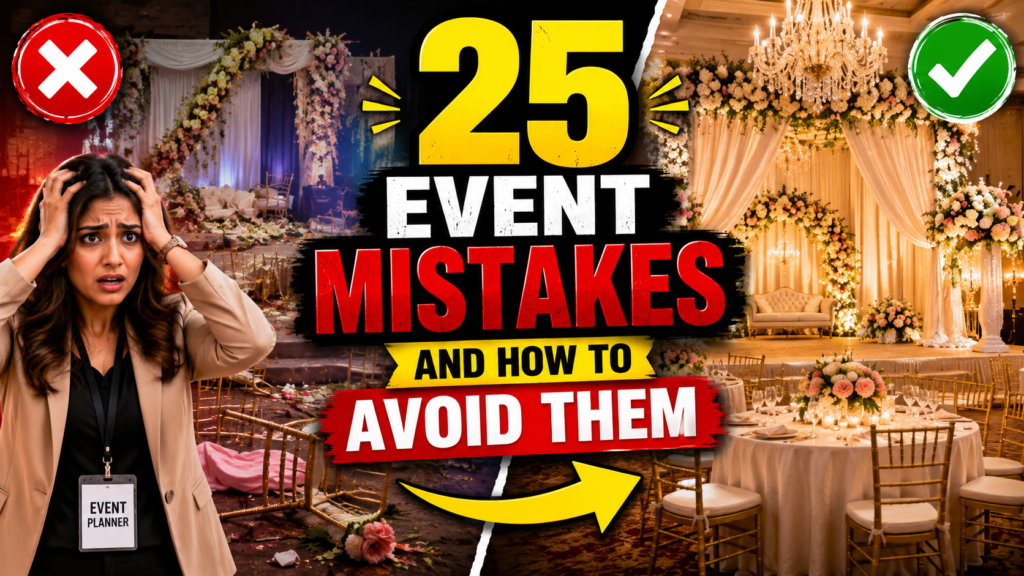
Plenty of events fall apart for the same handful of reasons. A caterer runs late with no backup lined up. A guest list gets tracked in three different places at once. A budget looks fine on paper until the final invoices arrive. None of these problems are unusual, and none of them are really surprises either, since they show up again and again across weddings, corporate events, and everything in between.
This guide is about the small, easy-to-overlook event planning mistakes that cause most of the stress on event day. A missed deadline. A vague verbal agreement. A “we’ll figure that out later” that never actually gets figured out.
The good part is that almost every mistake below follows a pattern, which means it can be planned around. Let’s walk through them.
Why Event Planning Mistakes Happen
Before the list, it helps to understand why these mistakes keep repeating.
Most of it comes down to five things: lack of preparation, which means booking a venue before deciding what the event is actually for; poor communication, where everyone assumes someone else already has it handled; budget limitations, since the number on the spreadsheet and the number in reality rarely match; last-minute decisions, where calls that needed to happen months earlier keep getting pushed off; and inadequate contingency planning, which usually just means hoping nothing goes wrong instead of preparing for the fact that something will.
Once these patterns are visible, the 25 mistakes below stop feeling random. They start feeling almost predictable.
25 Common Event Planning Mistakes and How to Avoid Them
1. Starting the planning too late. This is one of the most common mistakes, and often the most damaging. Vendors get booked up, venues lose availability, and every decision after that gets rushed instead of thought through. Give yourself at least three to six months for a mid-sized event, longer if it’s a big one. A good rule of thumb is to work backward from the event date rather than forward from today.
2. Not setting clear goals. An event without a clear purpose tends to feel scattered. Is this about closing deals, celebrating a milestone, or building community? That answer shapes everything that follows. Write down one main goal and two supporting ones before booking anything, and share that goal with the full team so decisions stay consistent.
3. Ignoring the budget. Costs sneak up quickly. A little extra for florals here, a bit more for lighting there, and suddenly the total is far higher than expected. A real spreadsheet, not a mental estimate, with a ten to fifteen percent buffer built in, prevents most of this. Keeping every quote in one place also helps, since scattered emails are where budgets quietly get lost.
4. Choosing the wrong venue. A venue that looks great in photos does not always fit the actual guest count or layout needed. Visiting in person and confirming true capacity, not just the number listed online, avoids most of these surprises. It also helps to see the space set up for a group close to the expected size.
5. Poor guest list management. Messy RSVPs turn into catering guesswork and seating chaos, usually the week of the event when there is little time left to fix anything. A proper RSVP system, even a shared spreadsheet, along with a firm cutoff date, solves most of this. Locking in headcounts with vendors about two weeks after that cutoff gives enough of a buffer.
6. Skipping contracts. A verbal agreement is not the same as a signed one, and informal deals can fall apart the moment a vendor gets a better offer elsewhere. Getting everything in writing, including pricing, timelines, and cancellation terms, protects both sides. It also pays to actually read the force majeure clause, especially for anything happening outdoors.
7. Hiring vendors without research. The cheapest quote is not always the best deal once the risk of a no-show is factored in. Checking reviews, asking for references, and actually calling one of them tends to reveal a lot. A vendor who hesitates when asked for a reference is usually telling you something.
8. No backup plan. Something unexpected happens at almost every event. The real question is whether it was planned for in advance or handled live in front of guests. Writing down the top three risks, along with a real answer for each, and assigning one specific person to own that plan makes a noticeable difference.
9. Poor communication. A surprising number of event day problems trace back to simple miscommunication rather than any actual disaster. A pre-event briefing, along with one clear point of contact, solves most of this. A single shared group chat also tends to work far better than several scattered text threads.
10. A weak timeline. A loose schedule feels flexible right up until it causes one part of the event to run into the next. Building a minute-by-minute run of show and sharing it with everyone involved keeps things on track. Adding fifteen-minute buffers between transitions helps absorb the small delays that are almost guaranteed to happen.
11. Ignoring permits. Amplified sound, alcohol service, and public spaces often require permits that get overlooked until it is nearly too late. Researching local requirements early, since approval can take weeks, avoids last-minute scrambling. Bringing physical copies on site also helps, since a saved email does little good without a working phone.
12. Underestimating setup time. Rushed setups are where small mistakes tend to hide, from crooked signage to an untested microphone. Doubling the estimated setup time, and taking a venue walk-through the day before whenever possible, prevents most of this.
13. Poor seating arrangements. Random seating charts can create awkward dynamics quickly, especially at events where family or workplace relationships are already complicated. Planning seating around relationships and accessibility, rather than convenience, avoids most friction. For anything over thirty guests, place cards tend to save a lot of confusion at the door.
14. Forgetting the guest experience. It is easy to get so focused on logistics that the actual guest experience gets overlooked. Walking through the entire event from parking to exit, or asking someone unfamiliar with the plan to do the same, tends to reveal what feels off before guests ever notice it.
15. Overloading the schedule. Adding more activities does not automatically make an event better, and often just makes it exhausting. Choosing three to five moments that genuinely matter, and giving each one room to land, tends to work far better. Short breaks between high-energy segments also give guests a chance to reset.
16. Ignoring accessibility. Ramps, accessible seating, and dietary accommodations are often treated as extras when they should be treated as basics. Asking about accessibility needs during registration, rather than after someone has already arrived, allows enough time to actually plan for them.
17. Inadequate staffing. Too few staff members mean small issues turn into visible delays right when guests are watching closest. Staffing up for peak moments such as arrival, meal service, and departure, even if it means thinner coverage elsewhere, keeps things running smoothly. Keeping one or two people unassigned so they can float where needed also helps.
18. No emergency plan. Medical issues, severe weather, and security concerns are uncomfortable to think about, which is exactly why they often get skipped. Mapping out exits, first aid resources, and emergency contacts ahead of time, and briefing every staff member rather than just management, closes this gap.
19. Poor audio-visual planning. Mic feedback and a projector failing mid-presentation are among the most visible event problems. Testing everything the day before, keeping backups for anything battery-powered, and giving one person the sole responsibility for AV prevents most of these issues.
20. Lack of branding for corporate events. A generic setup can make even a well-run event feel forgettable. Weaving logos and colors consistently through the space, rather than placing them on a single banner near the entrance, strengthens the overall impression. Carrying that same branding into the registration page and follow-up email extends it further.
21. Forgetting the follow-ups. So much energy goes into the event itself that the days right after often get ignored completely. A short thank-you message and feedback survey within forty-eight hours keeps engagement high. Including a few photos tends to get a stronger response than plain text alone.
22. Not assigning responsibilities. Assuming someone else has a task covered is one of the easiest ways for something important to fall through. A simple ownership list, with one task and one name attached to each item, removes most of the ambiguity. Saying assignments out loud during a team meeting also helps them stick better than a document that gets skimmed once.
23. Overcomplicating décor. More decoration does not always look better, and often just looks cluttered while costing more. Choosing two or three focal points, rather than decorating every surface, tends to create a cleaner and more photogenic result.
24. Ignoring weather forecasts. Outdoor events depend heavily on weather, yet the forecast often does not get checked until the morning of the event. Watching the forecast starting about a week out, confirming an indoor or tented backup ahead of time, and setting a firm decision deadline, such as four hours before doors open, avoids last-minute panic.
25. Not hiring a professional event planner when it is needed. Some events are genuinely manageable without outside help. Others quietly outgrow what one person can handle without something slipping. Being honest about available time and expertise before the final weeks arrive makes it easier to bring in support early, even if it is only day-of coordination.
Conclusion
Avoiding event planning mistakes isn’t about perfection. It’s about starting early, communicating clearly, and having real answers ready when things don’t go as planned. Smooth events aren’t the ones where nothing went wrong — they’re the ones where the team was ready anyway.
Related Blogs
25 Event Planning Mistakes That Can Ruin Your Event (And How Professionals Avoid Them)
Common Corporate Event Planning Mistakes & How to Avoid Them